
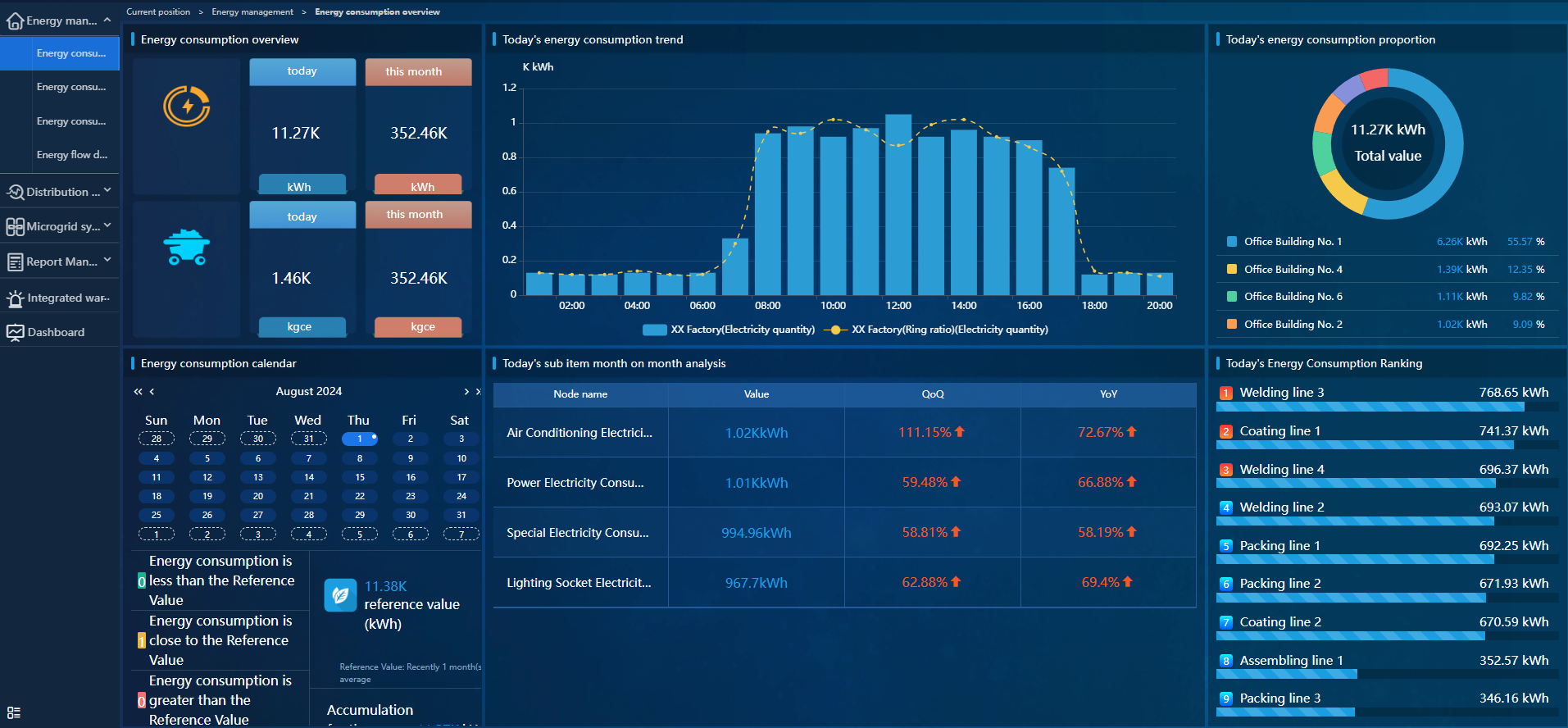
EcoChainer’s Energy Management Software Platform combines fixed core functions with optional extensions, helping projects start with a stable software foundation and expand only where needed.
The software is structured in three parts: a fixed core platform, application-focused packages, and optional extensions that can be added based on project requirements.
The fixed software foundation for system management, monitoring, alarms, reporting, and daily use.
Scenario-based function groups for building energy management, sub-metering and billing, power monitoring, pump room projects, and other applications.
Project-based modules for advanced analysis, integration, visualization, control, and industry-specific requirements.
The core platform provides the fixed software foundation used across standard deployments, supporting day-to-day management, monitoring, reporting, and system operation.

Support project configuration, organizational structure, user roles, account management, and permission control to keep the software structured and manageable from the start.

Monitor energy data, device status, and operating conditions in real time, with access to current readings, point status, and ongoing system visibility.

Review historical records, trend curves, and time-based comparisons to understand changes in performance, usage, and operating behavior.

Generate structured reports by energy type, location, hierarchy, or time period, with export support for standardized reporting and record keeping.
Detect abnormal conditions through system alarms and event monitoring, helping projects identify issues earlier and manage follow-up more consistently.

Turn raw data into usable views for comparison, statistics, trend analysis, and daily decision support across projects and monitored assets.
The platform can be configured into different application packages depending on project type, monitoring scope, and operational requirements.

Supports project-level energy overview, category-based energy analysis, point distribution visibility, ranking comparison, sub-item energy breakdown, trend analysis, and energy reporting for building and facility projects.

Supports energy metering, account management, billing generation, pricing models, transaction tracking, and financial overview for projects that require energy allocation and charging logic.
Supports electrical distribution visibility, real-time electrical parameter monitoring, topology visualization, load analysis, transformer monitoring, alarm logic, and electrical data analysis.
Supports pump room operation overview, device-level monitoring, energy efficiency analysis, alarm workflow, visualization, and system management for pump room applications.

Supports real-time point monitoring, historical curves, strategy triggering, linkage response, and display output for underground garage air quality control projects.
Optional extensions are added based on project scope, industry needs, integration requirements, and operational goals. They allow the platform to remain structured in standard deployment while supporting more advanced use cases where needed.
Analyze energy flow and compare performance across areas, systems, and operating benchmarks.
Support carbon visibility and normalized energy conversion for reporting and comparison.
Include cooling and heating energy metering for broader HVAC-related monitoring and reporting.
Add temperature, humidity, smoke, water leakage, and other environmental values to the platform.
Expand compatibility with third-party meters and external devices in mixed project environments.
Enable structured data exchange with external systems and software platforms through APIs.
Support selected remote control actions for projects that require response beyond monitoring.
Configure rule-based workflows, condition triggers, and automated response logic.
Create coordinated actions between monitored events and downstream system responses.
Provide configurable 2D views and 3D digital twin visualization for clearer system presentation.
Combine selected security monitoring, video playback, and access records in one extended view.
Support large-screen dashboards and public-facing display output for monitoring presentation.
The software is configured in a structured way to keep deployment practical and avoid unnecessary complexity in the initial project phase.

Deploy the fixed software foundation required for monitoring, reporting, alarms, and daily system management.

Choose the application package that matches the project scope, such as building energy management, sub-metering and billing, power monitoring, or pump room monitoring.

Expand the platform with advanced analysis, integration, control, or visualization modules only where the project requires them.
Base functions provide the software foundation for standard deployment and daily use. Optional extensions are selected based on project scope, integration requirements, and operational goals.
The software platform is suitable for projects that require structured data visibility, local deployment, and room for future functional expansion.
Get the Right Software Configuration for Your Project
Whether the project starts with standard monitoring or requires more advanced analysis, integration, billing, or control logic, EcoChainer’s software platform can be configured with the right combination of fixed functions and optional extensions.

We’ll recommend the right monitoring solution.