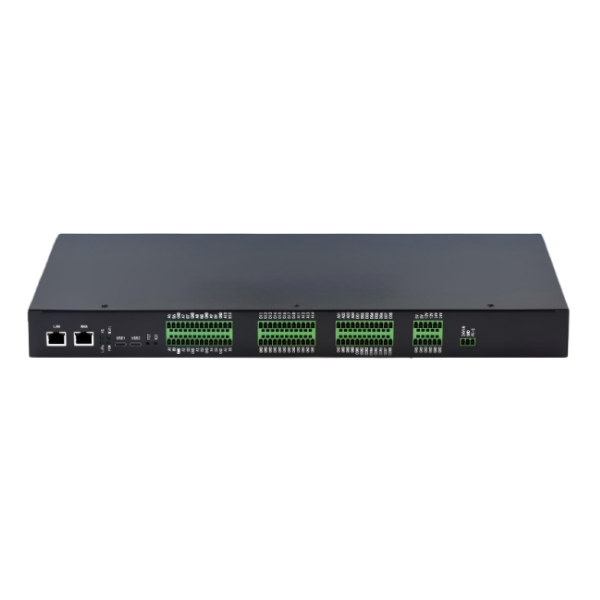
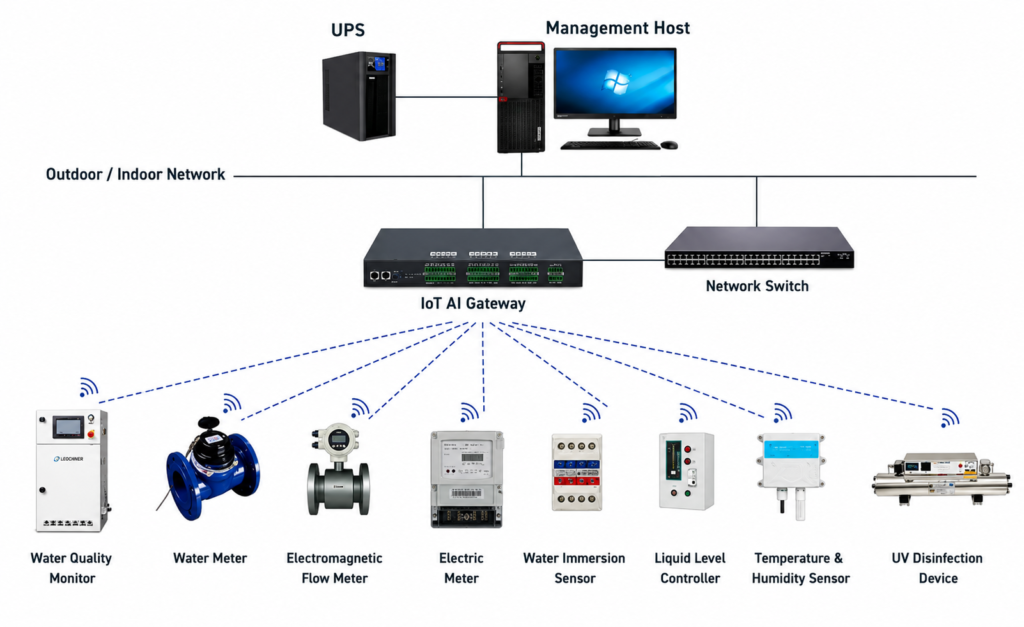
The ECSF101 industrial edge AI gateway is designed for local IoT data acquisition, industrial device integration, and edge-side monitoring applications. Supporting RS485, LoRa, Ethernet, AI/AO, and DI/DO interfaces, the gateway enables centralized management of meters, sensors, and industrial devices for energy monitoring, environmental monitoring, equipment management, and industrial automation systems without cloud dependency.
Supports centralized collection and management of water meters, energy meters, gas meters, heat meters, sensors, and industrial field devices.
Built-in edge computing architecture supports local data processing and device linkage applications.
Supports industrial communication protocols including Modbus-RTU and CJ188 for field device integration.
Equipped with AI/AO, DI/DO, RS485, LoRa, WiFi, and Ethernet communication interfaces.
Supports local web-based parameter configuration and device management.
Supports device linkage control based on device attributes and time-based logic conditions.
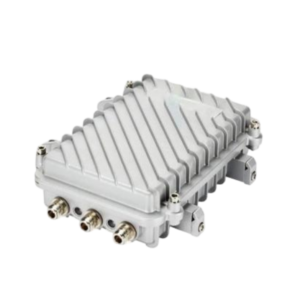
Metal enclosure design with industrial surge protection and hardware watchdog functionality.
Supports heartbeat monitoring, watchdog restart, power monitoring, and automatic recovery functions.
| Model | ECSF101 |
| Main Processor | Quad-Core Cortex-A7, 1.2GHz |
| Memory | 1GB DDR3L (Optional 2GB) |
| Storage | 8GB eMMC (Optional 16GB) |
| Power Supply | AC220V |
| Antenna Interfaces | WiFi / LoRa Antenna Interfaces |
| Debug Interface | USB Type-C, Serial Debugging, 115200N81 |
| Upgrade Interface | USB Type-C Firmware Upgrade |
| Network Interfaces |
1 × WAN Port 1 × LAN Port |
| WiFi Interface | WiFi AP Mode, Local Web Configuration |
| LoRa Interface |
8 Uplink Channels, 1 Downlink Channel Supports SF7 / 8 / 9 / 10 Supports LoRaWAN Class A / C |
| RS485 Interfaces |
10 × RS485 Interfaces Up to 32 Devices per Interface |
| DI Interfaces | 8 × DI Interfaces, Optical Isolation |
| DO Interfaces | 8 × DO Interfaces, Relay Output |
| AI Interfaces | 4 × AI Interfaces, 4–20mA Input |
| AO Interfaces | 4 × AO Interfaces, 4–20mA Output |
| Temperature Monitoring | Real-Time Internal Temperature Monitoring |
| Hardware Watchdog | System Automatic Restart |
| DC Power Output | 2 × 12V Outputs, 2 × 24V Outputs |
| Power Monitoring | External Power Detection |
| Buzzer | System Power-On Indication |
| Networking Method | Ethernet Networking |


Looking for pricing or more details on this product?
Can’t find what you’re looking for? Tell us your requirements.

We’ll recommend the right monitoring solution.